



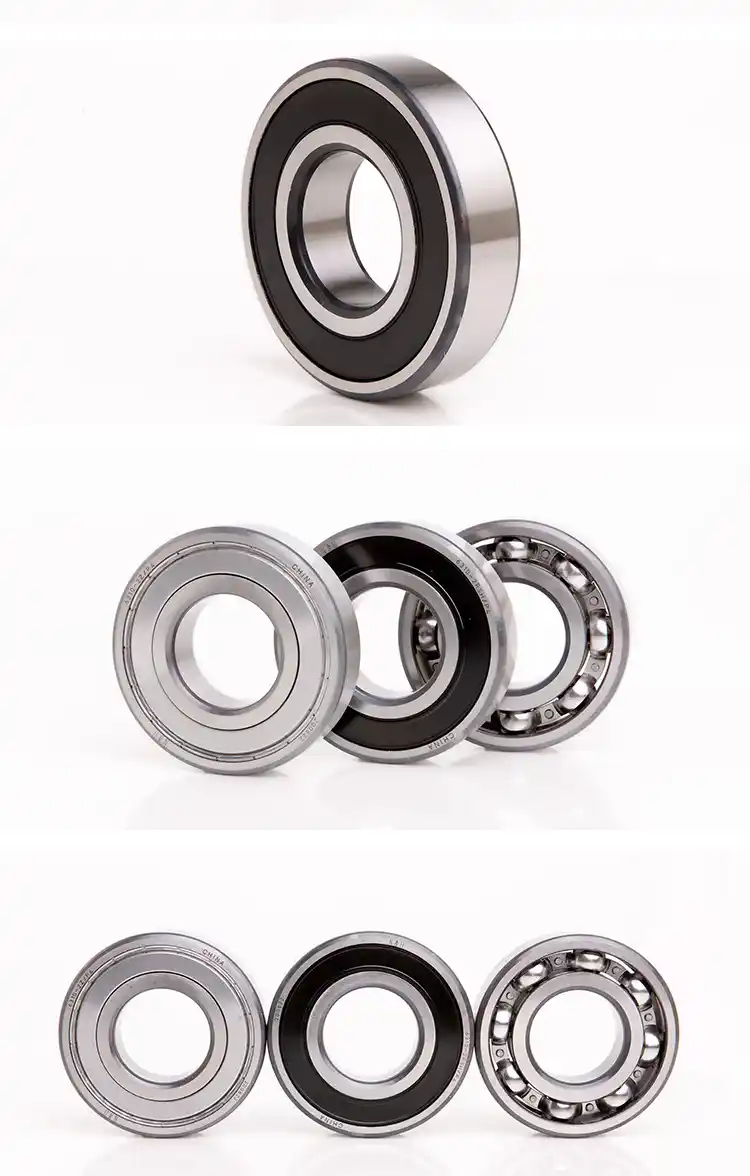
Sealed deep groove ball bearings are the workhorses of modern industry. From electric motors and automotive components to agricultural machinery and household appliances, these bearings are everywhere – and for good reason. They are simple, versatile, and capable of handling both radial and axial loads with minimal friction.
But here is the catch: a deep groove ball bearing is only as reliable as its seal. The sealing performance of a sealed deep groove ball bearing directly affects its service life. In fact, many premature bearing failures in recent years have been traced back to sealing problems. When the seal fails, contaminants enter, lubricant leaks out, and the bearing fails – often long before its calculated fatigue life is reached.
So, what determines whether a sealed deep groove ball bearing keeps running smoothly or fails prematurely? This article breaks down the key factors that influence sealing performance, helping you make better selection and maintenance decisions.
The most obvious factor is the seal itself. Deep groove ball bearings are available in several sealing configurations, each with distinct performance characteristics.
Shields are sheet steel covers fitted into the outer ring, forming a narrow gap with the inner ring. They protect against dirt and debris without creating friction losses. However, because they do not make contact with the inner ring, their sealing effectiveness is limited – they keep out large particles but cannot reliably retain grease or block fine contaminants and moisture.
Best for: Clean environments where speed is a priority and contamination risk is low.
Non-contact seals offer better sealing effectiveness than shields while maintaining the same speed capability. They are made of sheet steel reinforced with NBR (nitrile rubber) and form an extremely narrow gap with the inner ring shoulder. The "non-contact" designation means they do not rub against the inner ring, so friction and heat generation remain minimal.
Best for: Applications that need better contamination protection than shields but cannot tolerate the friction of contact seals.
Low-friction seals represent a middle ground. They provide better sealing effectiveness than non-contact seals and can operate at the same speeds as shields. They make virtually no contact with the inner ring shoulder, keeping friction to a minimum.
Best for: Applications where contamination risk is moderate but speed and efficiency cannot be compromised.
Contact seals provide the highest level of sealing effectiveness. They are made of sheet steel reinforced with NBR or FKM (fluoroelastomer) and make positive contact with a recess or shoulder on the inner ring. This positive contact creates a reliable barrier against contaminants and effectively retains lubricant.
However, there is a trade-off: contact seals generate friction, which increases heat and reduces speed capability. Contact-sealed bearings typically have speed ratings that are 50 to 60 percent of the equivalent open bearing. They are also not recommended for high-speed applications because the friction between the seal and inner ring can cause excessive temperature rise.
Best for: Harsh, dirty, or wet environments where contamination protection is critical and speed is moderate.
The lubricant inside a sealed deep groove ball bearing does more than reduce friction – it also plays a role in sealing. Grease acts as a secondary barrier, helping to block contaminants from migrating into the bearing interior.
The rheological properties of grease – particularly its power-law index – significantly affect sealing performance. Research has shown that choosing a grease with a smaller power-law index can effectively reduce the leakage rate. The geometric structure of the sealing element and the bearing operating conditions also interact with the grease properties, with the degree of influence directly related to the grease's rheological behavior.
Getting the grease fill quantity right is critical. Too much grease, and the excess is churned by the rolling elements, increasing pressure inside the bearing cavity and forcing lubricant past the seals. Too little grease, and the bearing runs dry, leading to rapid wear and failure.
For grease-lubricated sealed deep groove ball bearings, optimal fill rates typically fall between 30% and 40% of the bearing's internal free volume, depending on the specific application and operating conditions. Exceeding this range accelerates leakage; falling below it compromises lubrication.
Over time, grease degrades due to heat, oxidation, and mechanical shearing. As the grease breaks down, its consistency changes, and its ability to stay inside the bearing – and keep contaminants out – diminishes. This is why sealed bearings are often described as "greased for life"; the grease is expected to last the bearing's service life, but only if the operating conditions remain within design parameters.
The environment in which a deep groove ball bearing operates has a profound impact on its sealing performance.
Speed affects seal performance in two ways. First, higher speeds generate more centrifugal force, which can push lubricant outward against the seals, increasing the risk of leakage. Second, high speeds generate more heat, which reduces grease viscosity and makes it easier for the lubricant to escape.
As noted earlier, contact seals have significantly lower speed ratings than shields or non-contact seals. For high-speed applications, non-contact seals or shields are the safer choice.
Heat is the enemy of both seals and lubricants. Elevated temperatures:
Accelerate grease oxidation and degradation
Reduce grease viscosity, promoting leakage
Cause seal materials (particularly rubber compounds) to harden, crack, or lose their elasticity
Increase thermal expansion, which can alter seal clearances and contact pressures
Most standard sealed deep groove ball bearings are rated for operating temperatures between –30°C and 100°C. For higher temperatures, special seal materials (such as FKM) and high-temperature greases are required.
This is a detail that is often overlooked. Sealed and shielded deep groove ball bearings are typically designed for applications where the inner ring rotates. When used in outer-ring-rotating applications at high speeds, the filled grease may leak out more readily because the sealing geometry and centrifugal forces are optimized for inner-ring rotation. If your application requires outer-ring rotation, consult the bearing manufacturer for specific recommendations.
The clearance between the seal and the inner ring – and the geometry of the seal itself – directly affects sealing performance.
Research has shown that both radial seal clearance and axial seal clearance significantly influence grease leakage and dust exclusion performance. Excessive clearance allows lubricant to escape and contaminants to enter; insufficient clearance increases friction and generates abnormal heat.
The geometry of the sealing lip – including parameters such as lip angle, lip thickness, and lip corner radius – affects how the seal interacts with the lubricant and the inner ring. Studies have found that as the initial oil film thickness or contact width of the sealing lip increases, the grease leakage rate first decreases and then increases. This non-linear behavior means that seal design must be carefully optimized for each application.
Even the best-designed seal cannot compensate for poor installation practices. Common mistakes that compromise seal performance include:
Damaging the seal lip during mounting – sharp edges on the shaft or housing can cut or deform the seal
Using excessive force – pressing the bearing incorrectly can distort the seal or displace it from its groove
Contaminating the bearing before installation – dirt or debris introduced during handling can get trapped under the seal
Using the wrong mounting method – for sealed bearings, induction heating is preferred over press-fitting, which can damage seals
Proper handling and installation are just as important as correct selection.
Beyond the seal itself, the internal geometry of the deep groove ball bearing influences how well the seal performs.
Research indicates that grease leakage rate decreases initially and then increases as the outer groove curvature radius increases. In other words, there is an optimal curvature that minimizes leakage. This is a factor built into the bearing design – not something end users can adjust – but it underscores why choosing a quality bearing from a reputable manufacturer matters.
Larger radial clearances tend to increase grease leakage rates. This is because greater clearance allows more movement of the rolling elements, which can pump lubricant through the bearing and toward the seals. Conversely, smaller clearances reduce leakage but may compromise load capacity and heat dissipation.
Cage pocket diameter and guide clearance also affect sealing performance. Larger cage pocket diameters and guide clearances have been shown to reduce grease leakage rates. The cage influences how grease is distributed and how much churning occurs inside the bearing cavity.
Once contaminants begin to enter a sealed deep groove ball bearing, the situation deteriorates rapidly. Abrasive particles get trapped between the seal and the inner ring, wearing the seal lip and creating larger clearances. Larger clearances allow more contaminants in and more grease out, accelerating the cycle of degradation.
This is why proper seal selection for the specific operating environment is so critical. A seal that works well in a clean workshop may fail within days in a dusty quarry or a wet food-processing plant.
Selecting the right sealed deep groove ball bearing requires balancing multiple factors:
| Consideration | What to Look For |
|---|---|
| Operating environment | Clean → shield (Z); Dusty/wet → contact seal (RSH, RS1, RS2) |
| Speed requirement | High speed → shield or non-contact seal (RZ, RSL) |
| Temperature | Standard → NBR seals; High temp → FKM seals |
| Lubrication life | Pre-greased sealed bearings with optimal fill rate (30–40%) |
| Installation | Induction heating preferred; avoid seal damage |
BCHH Bearing has been manufacturing and supplying high-quality bearings since 2005. With ISO 9001 certification and exports to over 30 countries worldwide, BCHH offers a comprehensive range of deep groove ball bearings in sealed, shielded, and open configurations to suit every application.
Whether you need standard deep groove ball bearings for electric motors or specialty sealed bearings for harsh environments, BCHH provides reliable products backed by decades of engineering experience. Visit the deep groove ball bearing product page to explore the full range, or contact the BCHH team for technical support and application-specific recommendations.
The sealing performance of a sealed deep groove ball bearing is not determined by a single factor. It is the result of an interplay between seal type and design, lubricant selection and fill quantity, operating conditions (speed, temperature, and rotation direction), seal clearance and geometry, installation quality, and bearing internal geometry.
Understanding these factors allows you to make informed decisions – selecting the right bearing for your application, installing it correctly, and identifying potential issues before they lead to failure.
When in doubt, consult the experts. BCHH's technical team is ready to help you navigate the complexities of deep groove ball bearing selection and ensure your equipment runs reliably, day in and day out.
"To make the best quality in most competitive price",is our principle and "To support our clients enlarge their local market in max" is our continuous target
 Fast Shipping & Global Delivery
 100% Guaranteed Quality
 Safe Transaction
 Free Samples, Request